
Over 180 leaders from research, industry, government and EU institutions met in Brussels to explore how Europe can turn scientific breakthroughs into globally competitive technologies. Marking 15 years of EuroTech, the Summit also celebrated the Alliance’s achievements and its emerging scientific talent while looking ahead to new ambitions for European collaboration.
4 November 2026 | Brussels – What Europe can invent, build and scale – and where tomorrow’s industries take root – will depend on the choices we make today. This was the focus of the EuroTech Summit 2026, “Unlocking Frontier Tech for Europe,” hosted by the EuroTech Universities Alliance on 28 October. As the EU negotiates its next long-term budget, Horizon Europe (FP10) and the European Competitiveness Fund (ECF), the level of ambition and investment will be critical to turning frontier technologies into competitive companies, industrial strength and societal impact.
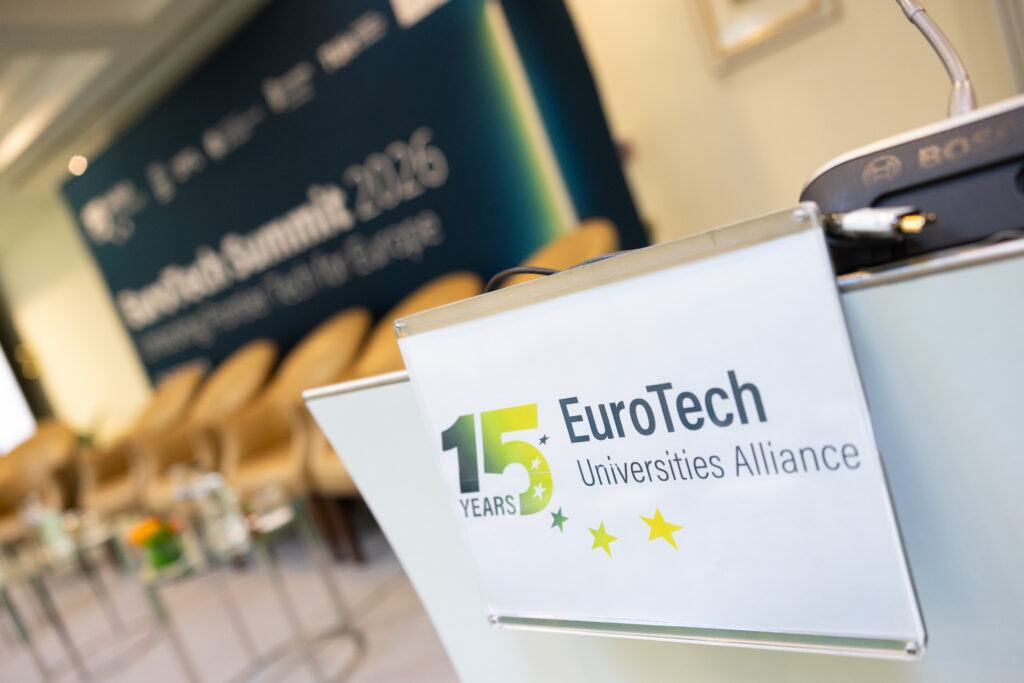
The event also celebrated 15 years of the EuroTech Universities Alliance, marking a new chapter in its ambition to unite Europe’s leading technological universities and turn collaboration into breakthroughs and advances for Europe.
Connecting science, industry and European policy
Where should Europe aim to lead at the next frontiers of science and technology, and how can it invest boldly and strategically to turn that ambition into competitive advantage and real benefits for society? The Summit tackled this question across four strategic fields at the heart of the proposed European Competitiveness Fund: Digital and enabling technologies; Clean tech and energy; Health and biotechnology; and Security and space.
The programme opened with a video keynote by Henna Virkkunen, Executive Vice-President of the European Commission for Tech Sovereignty, Security and Democracy, alongside contributions from Clément Beaune, French High Commissioner for Strategy and Planning, and Bernard Magenhann, Director-General of the European Commission’s Joint Research Centre.
At the heart of the Summit were the stories of deep-tech entrepreneurs turning excellent research into emerging technologies and businesses. Founders from Praedon, RIFT, Bloom Biorenewables, Differential Bio, FullView Medical and Tonagena showcased their innovations and shared first-hand experiences of the challenges involved in developing, financing and scaling breakthrough technologies. Their pitches sparked interactive fishbowl discussions, bringing the audience directly into the debate on what it takes to bridge the gap between technological ambition and viable solutions.
These entrepreneurial perspectives were complemented by insights from presidents and leading researchers from Europe’s technological universities, alongside industrial and international partners including ASML, the International Energy Agency and the European Space Agency, and representatives of the European Commission’s DG CNECT, DG RTD, DG CLIMA, DG DEFIS, DG HOME and DG JRC.
Across these diverse perspectives, several key messages emerged on the choices and priorities that should shape Europe’s next research, innovation and competitiveness agenda:
- Invest in the technologies of tomorrow, not just those we already know. Europe’s technological leadership requires sustained investment in (collaborative) frontier research, including high-risk ideas and breakthroughs at the intersection of disciplines, alongside the infrastructures and capabilities needed to turn discoveries into European strengths.
- Technology is key to Europe’s competitiveness and wider societal ambitions. From digitalised and cleaner industry to better healthcare and energy security, tech universities drive technological advances that strengthen competitiveness and societal progress, while developing the talent to shape a more sustainable and resilient Europe.
- Europe’s next competitive advantage lies in connecting its ecosystems. Innovation is not a one-way journey from lab to market: real-world challenges also drive new discoveries. Connecting research, industry, entrepreneurs and infrastructures across borders can turn Europe’s fragmented excellence into collective strength.
- Europe must become as good at scaling deep tech as it is at creating it. Beyond capital, European start-ups need access to testing facilities, industrial partners and first customers across Europe to turn breakthroughs into market-ready technologies and build globally competitive companies anchored in Europe.
- Scientific expertise must help shape Europe’s technological choices. Stronger dialogue between researchers and policymakers is essential to anticipate emerging frontiers, understand strategic dependencies and societal implications, and guide Europe’s future R&I investments.
Celebrating Europe’s next generation of researchers and innovators
A highlight of the Summit was the EuroTech Rising Stars Award 2026 ceremony, recognising outstanding early-career researchers and innovators pushing the boundaries of science and turning bold ideas into real-world impact.
Across two categories, Rising Research Stars and Rising Innovation Stars, the awards celebrated six finalists from across the Alliance, with Yosta de Stigter (TU/e) taking first place in the Research track and Lukas Burgholzer (TUM) winning the Innovation track.
Yosta is developing light-producing proteins for more accessible medical diagnostics, while runner-up Omer Can Karaman (EPFL) is exploring new ways to control light for photonic and quantum technologies. Third-place finalist Andrés Felipe Castro Méndez (TUM) is advancing next-generation solar cells.
In the Innovation track, Lukas is developing software to make quantum computers easier to use and integrate with conventional computing systems through Munich Quantum Software Company. Alexander Holm Ohrt (DTU) took second place for his work commercialising ultra-antireflective nanotechnology through LumenAR, while Hadas Omer (Technion) placed third for developing DNA-based capsules for more targeted drug delivery through DNAmi. A special mention went to Remco van Erp (EPFL) for his work on microfluidic cooling technology for high-performance AI and computing chips through his company, Corintis.
The Rising Stars Award showcases the talent and ambition emerging across the EuroTech Alliance, highlighting the importance of nurturing and retaining Europe’s next generation of researchers and innovators to sustain its scientific excellence, strengthen its technological capabilities and enhance its long-term competitiveness.
Explore the EuroTech Rising Stars Award 2026 nominees and finalists in the booklet.
15 years of EuroTech: building the next chapter
Since its founding in 2011, EuroTech has grown into an alliance of six leading universities of science and technology, pooling expertise and resources across borders to advance shared priorities.
Its Strategy 2030, launched earlier this year, sets the direction for the next phase: strengthening joint initiatives in research and innovation, developing shared infrastructures, bringing scientific expertise into European policymaking and forging closer ties between innovation ecosystems.
The Summit also marked the beginning of a new chapter for the EuroTech Universities Alliance, with the signing of accession agreements welcoming Czech Technical University in Prague (CTU) and Tallinn University of Technology (TalTech) as new members from 1 January 2027.
Thierry Coulhon, President of the EuroTech Universities Alliance and President of Institut Polytechnique de Paris, said:
“For 15 years, EuroTech has brought together Europe’s leading technical universities around a shared ambition: achieving more together than any of us could alone. With our Strategy 2030, we want to take this further, joining forces at the frontiers of research, innovation and infrastructures, connecting these efforts with education and skills through our sister alliance EuroTeQ, and bringing our scientific expertise into Europe’s strategic choices. Welcoming CTU and TalTech extends our geographical reach and connects complementary strengths and innovation ecosystems. Our vision is to not simply build a larger Alliance, but to deepen our ties, act together on a greater scale and make a real difference to Europe’s technological future.”
Further information
Follow the Summit highlights, award announcements, interviews, photos and videos on EuroTech’s LinkedIn page (#EuroTechSummit2026) and website.
The full event report will be published soon.
High-resolution event photos are available for media use upon request. Please contact the press contact below to obtain access.
Press contact
Gintare Medisauskaite
Senior Policy & Communication Manager
EuroTech Universities Alliance
Phone: +32 474 104 149
Email: [email protected]
Notes to editors
About the EuroTech Universities Alliance
The The EuroTech Universities Alliance is a strategic partnership of six leading universities of science and technology: the Technical University of Denmark (DTU), École polytechnique fédérale de Lausanne (EPFL), Institut Polytechnique de Paris (IP Paris), Technion – Israel Institute of Technology, Eindhoven University of Technology (TU/e) and the Technical University of Munich (TUM).
Founded in 2011, the Alliance combines complementary strengths in infrastructure, research, innovation, and education, to address societal challenges and strengthen Europe’s competitiveness, sustainability and resilience. Through its Strategy 2030, EuroTech is advancing deeper cooperation, contributing scientific expertise to European policymaking and connecting research and innovation ecosystems to achieve greater collective impact.